Attenuation Ponds & Basins — SuDS Attenuation Contractors in East Sussex & Kent
An attenuation pond — also called an attenuation basin, detention basin or storage pond — holds surface water back during heavy rain and releases it slowly into a ditch or watercourse once the peak has passed. It's the standard way to stop new development, tracks and hardstanding from overwhelming the drainage downstream, and on the Wealden clay of Kent and East Sussex it's often the only SuDS option that actually works.
We design and build attenuation ponds across Battle, East Sussex and the wider South East — from small basins for a single dwelling or barn conversion to larger SuDS ponds serving housing schemes, commercial yards, farms and estates. We own all our own excavators, so we carry out the excavation, bank shaping, lining, inlet and outlet works and flow control installation ourselves rather than handing the job to subcontractors.
Why Sites in Kent and East Sussex Need Attenuation
Most of the Weald of Kent and East Sussex sits on heavy clay. Water doesn't soak away through it in any meaningful quantity, so a soakaway or infiltration system will fail a percolation test or silt up within a season. Where infiltration isn't possible, surface water has to be stored and released at a controlled rate — which is exactly what an attenuation pond does.
Planning authorities across the region, and the Lead Local Flood Authority for East Sussex and Kent, routinely require a surface water drainage strategy with attenuation as a condition of planning. Barn conversions, new dwellings, equestrian menages, commercial yards, agricultural buildings and farm tracks all typically need storage volume calculated for the site's impermeable area and a discharge rate limited to greenfield runoff.
There's also a practical problem on older sites. Development, new tracks and concreting over yards all increase the rate and volume of runoff reaching a ditch that was never designed for it. The result is erosion at the outfall, flooding downstream and water backing up onto the site. An attenuation pond with a correctly sized flow control solves both problems at once — it protects your land and the land below you.
Our Attenuation Pond Services
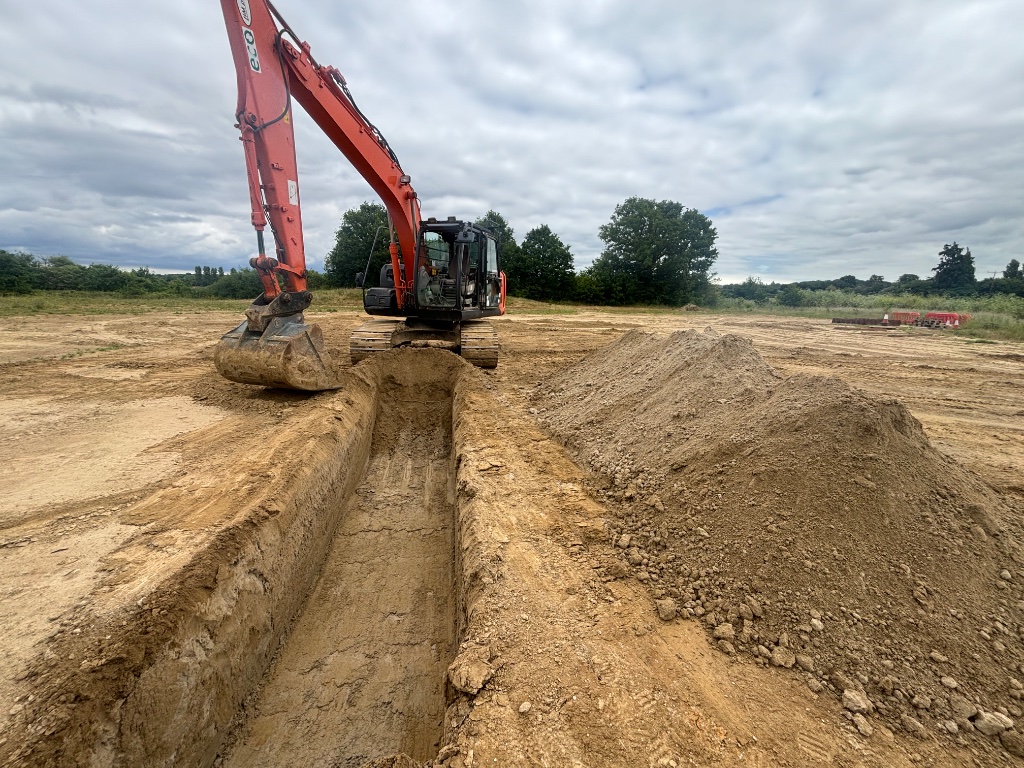
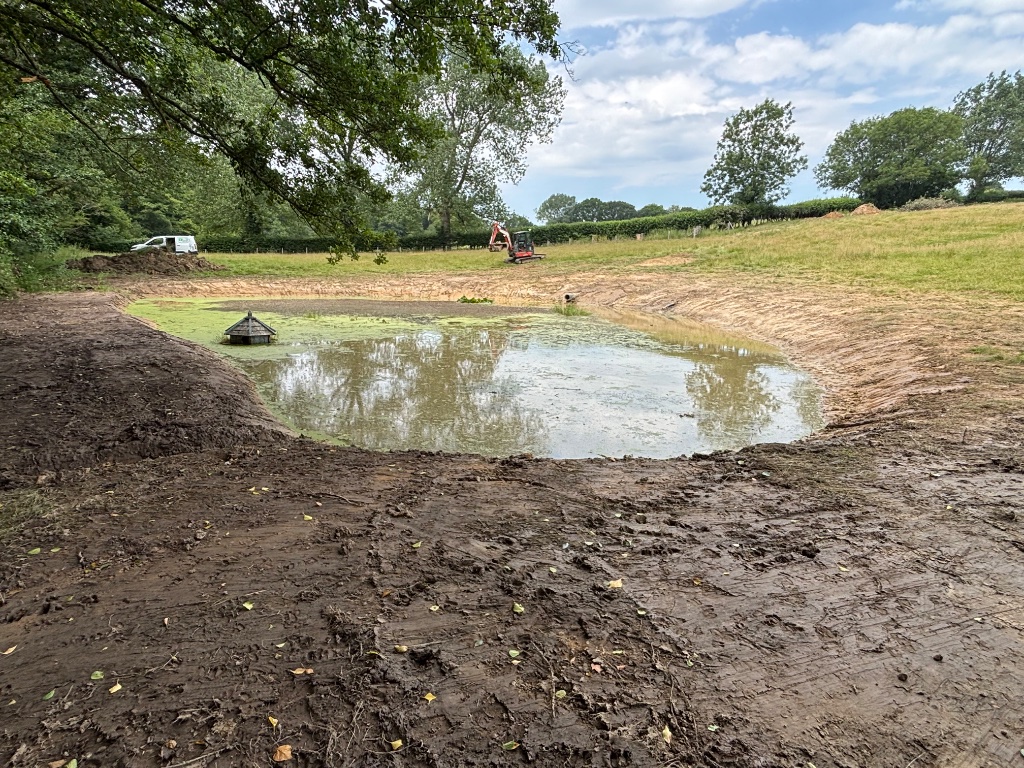
We build attenuation ponds from the ground up. That means excavating to the design profile, shaping and compacting the banks to a stable batter, forming the storage volume, and constructing the inlet, outlet and overflow so the pond fills, holds and empties as intended. Where the ground is permeable, or where the pond sits above a vulnerable aquifer, we line the basin in puddled clay or a suitable membrane to keep it watertight.
Flow control is the part that makes an attenuation pond work, and it's where poorly built schemes fail. We install orifice plates, hydrobrake-type vortex flow controls and weir outlets set to the permitted discharge rate, together with a silt trap or forebay upstream so sediment doesn't fill the storage volume. Outfalls are formed properly at the correct gradient so they don't wash out or block.
We also build the wider SuDS package around the pond — swales and filter drains feeding it, catchpits and silt traps protecting it, and headwalls and culverts taking the discharge under tracks and driveways. On clay sites we can combine storage with treatment and biodiversity by planting marginal species and forming a wetland margin, and we maintain and de-silt existing attenuation ponds where capacity has been lost to silt.
We work from your drainage design where you have one, or advise on sizing and layout where you don't. We're EUSR, NPORS, NRSWA and CSCS accredited, licensed waste carriers and carry £5m public liability, and we can provide the as-built details and photographs your building control or LLFA condition sign-off will ask for. Call 07376 622637 for a free site assessment and quotation.
Related Problems We Solve
Frequently Asked Questions
What is the difference between an attenuation pond and a retention pond?
An attenuation pond (or detention basin) is normally dry between storms — it fills during heavy rain and empties slowly through a flow control. A retention pond holds a permanent body of water with additional storage volume above it. We build both, and on many sites a pond with a permanent wet base and extra attenuation storage above is the best answer for drainage, amenity and biodiversity.
How big does an attenuation pond need to be?
The storage volume is calculated from the impermeable area draining to it, the permitted discharge rate and the design storm — commonly a 1 in 100 year event plus climate change allowance. Because the sizing depends on your site, we work to your drainage engineer's figures or calculate a suitable volume during the site assessment. A small basin for a driveway or barn conversion may only need a few cubic metres; a housing scheme may need hundreds.
Will an attenuation pond work on clay soil in East Sussex?
Yes — clay is exactly the situation attenuation is designed for. Because water won't infiltrate, the pond is built as a lined, watertight basin with a controlled outlet rather than an infiltration basin. We line in puddled clay or membrane and form a proper flow-controlled outfall, which is the approach the Lead Local Flood Authority expects to see on clay sites across the Weald.
Do I need planning permission or LLFA approval for an attenuation pond?
For development sites, surface water drainage including attenuation is normally dealt with as a planning condition and reviewed by the Lead Local Flood Authority. Discharging to a watercourse or ditch may also need consent from the Environment Agency or the relevant Internal Drainage Board. We can build to your approved design and provide the construction details needed to discharge the condition, and we advise on outfall consent requirements during the site visit.
Can you clean out or repair an existing attenuation pond?
Yes. Attenuation ponds lose capacity as silt builds up, and blocked flow controls or eroded banks are common. We de-silt basins, reinstate the design profile and storage volume, repair or replace flow control structures, rebuild washed-out outfalls and reinstate the inlet and forebay so the pond performs as designed again.
Which areas do you cover for attenuation pond works?
We're based in Battle, East Sussex and cover all of Kent and East Sussex, including Hastings, Bexhill, Eastbourne, Hailsham, Heathfield, Lewes, Rye, Robertsbridge, Tunbridge Wells, Cranbrook, Hawkhurst, Tenterden and the surrounding towns and villages. Call 07376 622637 to check your site.
Need Help With This Problem?
Call us for a free quote. Based in Battle, East Sussex — covering Kent and East Sussex. We respond within 24 hours.